Frequently Asked Questions
Questions
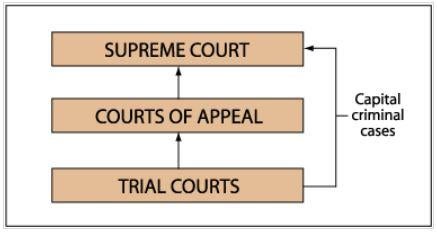

The Judicial Branch
The Court:
Interprets and applies the lawsExecutive Branch
The Governor, State Departments and Law Enforcement:
Signs laws and carries them outThe Legislative Branch
The State Senate and the State Assembly: Writes and passes laws
-
Civil Cases - When one person or business sues another. After trial, the Court decides if the party being sued must pay money to the person or business who filed the suit.
Small Claims Cases - When a person sues another for $7,500 or less. Lawyers are not allowed to argue the case, only the people who are involved argue the case.
Traffic Cases - When a person receives a ticket for an offense such as speeding.
Criminal Cases - When a person is accused of breaking the law a complaint is filed. If the person is found guilty, the judge tells the defendant to pay a fine or go to jail, or both. The two major kinds of criminal cases are misdemeanors and felonies.
- Misdemeanors: The person accused, if convicted, may only be sentenced to up to one year in the county jail. Misdemeanors include such offenses as shoplifting, vandalism, and drunk driving.
- Felonies: Are more serious than misdemeanors, and the accused, if convicted, may be sentenced to state prison. Felonies may include robbery, burglary, and murder. In some murder cases, the death penalty may be ordered.
There are three main types of Court proceedings in the criminal Court: Arraignments, Preliminary Hearings, and Trials.
Arraignment - At an arraignment, the suspect is brought before a judge to hear what crime he or she is accused of committing, informed of his or her rights, has bail set, and enters a plea.
Felony Preliminary Hearing - A judge hears the prosecutor's case to decide if the accused should go to trial.
Criminal Trial - The prosecutor explains to the judge or jury why the defendant is guilty, and the defendant's lawyer tells why the defendant is not guilty.
-
Judge - An elected public official who hears and decides cases in a Court of law.
Commissioner - A bench officer who is appointed by the judges to help with the Court's business. A commissioner also hears and decides cases at Court hearings and trials.
Bailiff - This person is responsible for the security of the judge, jury, and people visiting the courthouse. The bailiff is also responsible for the safety of the defendant in a criminal trial.
Court Reporter - The person who records the statements of all participants in a Court proceeding.
Court Clerk - The person who keeps records for the Court. The clerk also swears in witnesses and keeps exhibits safe.
Defense Attorney - A lawyer who defends someone accused of a crime in a criminal case or who represents the person being sued in a civil case.
Prosecuting or Plaintiff's Attorney - A lawyer who represents the people of the community in a criminal case or who represents the person who is suing the defendant in a civil case.
Jury - Twelve members of the community who decide the outcome of a criminal case or a civil case, when either party in the case asks for a jury trial instead of a trial to be heard by the judge.
Witness - A person who gives a statement in Court about what he or she saw, felt, or heard in the case.
Defendant - In a criminal case, the defendant is the person accused. In a civil case, it is the person who is being sued.
Plaintiff - In a criminal case, the plaintiffs are the People of the State of California (usually represented by the Shasta County District Attorney). In a civil case, the plaintiff is the person suing.
Interpreter - A person who translates English into other languages for people in Court who do not speak English.
Look for your name, the courtroom location, and the time your case will be heard on the calendar posted outside the Criminal Division Clerk's Office. If you are unable to find your name or locate a calendar, go to the Clerk's Office.
Bring any relevant paperwork having to do with your case, such as:
- Proper identification - Driver’s License, California ID Card, Social Security Card, or other picture identification.
- Name used when arrested (if different from current name).
- If cited, bring a copy of the citation.
- Letter from the prosecuting agency or Court regarding appearance.
- Copy of bond or cash bail receipt.
- Jail release paperwork.
- Sentencing paperwork relating to your case; for example, the fine payment slip, community service contract, any paperwork received while in custody, etc.
Yes, be prepared to present a picture identification card.
As a defendant, expect to be in Court for a substantial portion of the day to take care of all possible matters.
-
Arraignment - Reading of your Constitutional rights, advisement of the charges, entering a plea.
Pretrial Hearing - A conference between parties (prosecutor and defendant) regarding the settlement of the case.
Preliminary Hearing - A felony hearing by a judicial officer to determine if there is sufficient evidence to bind a defendant over for trial.
Jury/Court Trial - The examination of evidence and the decisions of the issues of law by a judge or jury to determine guilt or innocence.
Post Judgment Hearing - Any hearing after sentencing that would require a modification or change in the Court's order.
The Addicted Offender program offers individuals facing non-violent criminal charges for drug use and posession an opportunity to enter into a substance abuse recovery program in lieu of straight jail time. The requirements of this program are quite strict. The defendants are frequently tested for drugs and must attend substance abuse recovery meetings in addition to making Court appearances regularly.
If you have already established a monthly payment plan, payments may be made at Collections Division.
We accept Visa, Mastercard, and Discover Card.
You will be given a receipt when you pay in person. If you need a receipt by mail, please send a self-addressed stamped envelope along with your payment. Otherwise, your cancelled check will be your receipt.
Yes, with permission from the judge for felony and/or misdemeanor convictions only. You must appear before the judge and request jail time in lieu of payment. If your request is granted, be prepared to be taken into custody immediately. You are still responsible for paying any fees owed (eg: booking fees, lab fees, restitution, etc...)
A Failure to Appear (FTA) will be electronically removed by our office from your record within 24 to 48 hours of your court appearance.
Local rules are available free of charge online, or you may obtain copies from our office for a fee of $10.00.
The Court will accept faxed filings pursuant to Rule 2.303 of the California Rules of Court, which states that they must be transmitted via a fax filing agent.
Copies of any case filed within this court that has been deemed public record pursuant to statute, may be purchased in person during normal office hours or requested via U.S. Mail.
Please use the form CF-055 “Request for Record Search and/or Copies” and make check or money order payable to Shasta County Superior Court. If requesting copies via U.S. Mail, please be sure to include a self-addressed stamped envelope of sufficient size and postage for the return mailing of your 8.5 x 11 pages.
With the exception of juvenile court records, to obtain records otherwise deemed confidential, you must be a party to the case and authorized by statute to receive copies or have obtained a court order. You must also make your request in person with proper identification. Requests made via U.S. Mail will require a notarized signature.
Access to juvenile court records can only be obtained in accordance with Welfare and Institutions code 827. Availability of these records without a court order is restricted to certain court personnel, the minor, parents or guardian, attorneys involved in the case and other persons designated by the Presiding Judge of the Juvenile Court. Identification is required for all requests.
Cost for Copies:
• $0.50 per page.
• $40.00 per certification of a copy of paper, record, or single proceeding on file plus $0.50 per page (excluding family law judgments).
• $15.00 for certification of a family law judgment, plus $0.50 per page.
• $15.00 for searching for records or files, for each search takes longer than 10 minutes (includes index search), plus $0.50 per page.
• $15.00 for document authentication pursuant to court order, per signature, per page.
• For all other record related fees, please see the Statewide Civil Fee Schedule: Fee Schedule
Please note that standard copy requests of 10 pages or less are generally produced immediately, if the request is being made in person. If the request is made via U.S. Mail, please allow up two to four weeks for processing. For larger copy requests of more than 10 pages or requests for copies of case files that need to be retrieved from our archive’s storage building, there is no guaranteed turn-around time . However, please be assured that they will be processed as soon as possible.